This Month on Tybee
9 min read
Tybee Island in September 2026: Hurricane Season, Water, and Whether It's a Good Time to Come
The water sits in the low 80s, the summer crowds have gone, and NOAA gives the 2026 hurricane season a 75% chance of running below normal. The honest read on storms, swimming, and whether a September trip to Tybee is worth booking.
Edited by Admiral's Inn Editorial Team
Thursday of this week (September 10) is the statistical peak of the Atlantic hurricane season. That's not folklore. It's the National Hurricane Center's own climatology. And if you're holding a Tybee reservation this month, or hovering over the book button, that date is probably the thing you actually want addressed before anyone tells you about the water temperature.
So let's address it. With sources, in order: what the season is, what forecasters expect from this one specifically, what the long record says about this stretch of coast, and what you'd actually do in the rare week when it matters. Then the good news, which is genuinely good.
The season on paper
The Atlantic hurricane season runs June 1 through November 30, and NHC's climatology page is blunt about the shape of it: the peak is September 10, with most activity occurring between mid-August and mid-October. September isn't sneaky about this. It's the month forecasters watch hardest, and any honest guide to visiting a Georgia barrier island in September starts there.
What that peak means in practice is a probability curve, not a schedule. Most Septembers on Tybee produce beach weather, a handful of loud afternoon thunderstorms, and nothing else. Some produce a watch. A few produce a warning. Once in a long while, one produces an evacuation. The rest of this post is about how those odds look, this year and over 168 years of records, so you know what you're actually weighing.
What NOAA expects from 2026
Here's the part most hurricane-season posts can't offer you: this particular season is forecast to be a quiet one. NOAA's updated seasonal outlook, issued August 6, gives the 2026 Atlantic season a 75% chance of being below normal, against a 20% chance of near-normal and just a 5% chance of above-normal. The same outlook calls for 7–13 named storms, 2–6 hurricanes, and 0–2 major hurricanes. The full outlook is on NOAA's Climate Prediction Center site.
Two honest footnotes belong next to that. First, a seasonal outlook counts storms across the whole Atlantic basin. It says nothing about where any single storm goes, and a below-normal season can still steer its one hurricane somewhere inconvenient. Second, 75% is not 100%. But if you were going to pick a September to visit the Georgia coast, the one with a below-normal forecast is the one you'd pick. And it's better to say that with a citation than to mumble something soothing and hope.
One more data point, offered strictly as a snapshot: as of Sunday evening, September 6 (the night before this post went up), the National Hurricane Center's Atlantic map showed no tropical cyclones anywhere in the basin. That's a dated observation, not a promise. The map changes. Look at the live version for your own dates.
The long record
Now zoom all the way out. The National Weather Service office in Charleston, the office whose forecast area covers Tybee, keeps a tropical-cyclone climatology reaching back to 1851. From 1851 through 2018, 309 tropical cyclones tracked through the broader region, and 41 made landfall within the warning area: 25 hurricanes, 9 tropical storms, 7 depressions. Most arrived, as you'd expect, between August and October.
Forty-one landfalls in 168 years, spread across a multi-county stretch of coastline, works out to roughly one every four years somewhere along that shore. And "somewhere along that shore" covers a lot of coast. It's a number that earns respect without panic. Storms are a real feature of life here. A storm intersecting your particular week is genuinely uncommon.
If a storm does threaten
Tybee is a barrier island, and Chatham County plans accordingly. The county's emergency-management agency defines its first evacuation tier like this: "Evacuation Zone A: Areas east of the Truman Parkway and the Vernon River." Tybee sits well east of the Truman Parkway: when evacuations are ordered, the beach communities go first, not last. The county publishes its zones and an interactive map, worth two minutes of your time if you're visiting anytime during the season.
The practical version is short. If a system ever does aim this way while you're here, the information chain is public and clear: the National Hurricane Center for the storm itself, Chatham Emergency Management for local orders. US-80 is the one road off the island, so when officials say go, the right move is to go early rather than join the last-minute line at the causeway. That's the entire playbook, and in most Septembers you never open it.
The water is the argument for coming
Here's the other half of the September story, the one hurricane anxiety tends to crowd out: this is one of the best swimming months of the island's year.
NOAA runs a continuous water-temperature gauge at Fort Pulaski, just behind the island, the closest official station to Tybee's beach and a good proxy for it, though it sits in the river entrance rather than the surf itself. Averaged over the past seven years of hourly readings, September's mean is 80.9°F. The month cools as it goes: typically around 82–83°F in the first week, settling toward 79–80°F by the end. And this particular September opened warmer than any in that seven-year record: the gauge has been reading in the mid-80s over the first days of the month.
One honest wrinkle in that record, since this is a hurricane-season post: the within-month cooling is typical, not guaranteed. The sharpest late-September drop in those seven years came in 2020, when storm activity churned the late-month water down near 75°F. An outlier, but a real one. In an ordinary year, the difference between the first week of September and the last is three or four degrees, and you'd barely clock it standing waist-deep.
The water also holds. October's seven-year mean at the same gauge is 73.8°F: still a swimming temperature, and the last comfortably swimmable month of the year. Which sets up the least obvious fact in this whole post: October's water runs about six degrees warmer than April's: 73.8°F against 67.8°F. Autumn, not spring, is the warm shoulder of Tybee's year. The ocean spends all summer banking heat and spends fall giving it back slowly. If you're weighing a September trip against "maybe spring instead," the water has an opinion.
Air, rain, and evening light
On land, September is a mild step down from August, not a season change. Observations at that same Fort Pulaski station put the island's September days in the low 80s and its nights in the low 70s: a couple of degrees off high summer, with the ocean keeping the island's nights warmer than what inland forecasts suggest. The official NOAA climate normals for the Savannah area put September rainfall at 4.35 inches, down from August's 5.46. The wettest stretch of the year is behind you, though this is still coastal Georgia, and a rain shell is never a wasted pack.
The change you'll actually notice is the light. Sunset on the island is 7:40 PM on September 7 and 7:09 PM by September 30, per the U.S. Naval Observatory: half an hour of evening gone in a single month. Early September still gives you the after-dinner beach walk. By the end of the month, take the walk first and eat after.
What the island feels like this month
Quieter. We're not going to put a percentage on that (nobody publishes a reliable count of Tybee's crowds and we won't invent one), but the island's rhythm changes after Labor Day weekend, and you can see it in two verifiable places.
Parking is the first. Tybee's paid parking is enforced citywide, 8 AM to 8 PM, year-round, at $4 an hour. The price never drops, off-season or on. What changes in September is availability: you can actually find a space, at midday, near the beach you wanted. In August that sentence would be fiction.
And a September-specific note on the beach itself: Tybee's tide swings about six and a half feet between high and low, which means the beach at low tide is dramatically wider than at high, more of a difference than most visitors expect. With fewer people on the sand this month, a low-tide walk is about as much beach as you'll ever have to yourself here. Check NOAA's tide predictions for Tybee for your dates.
The calendar is the second. The island's programming starts drifting indoors: the Post Theater's fall slate picks up, the Monday farmers market runs on through October, and sea-turtle nesting season continues through October too, so give any marked nests on the beach their room. The full events rundown lives in this post's companion piece, What to Do on Tybee Island in September 2026. This post's job is the conditions. That one's is the calendar. Savannah's fall season is stirring as well, about half an hour from the island, and the companion post covers that side of things.
What to pack
August's list, minus nothing and plus one thing. Days are still shorts-and-sandals. The ocean is still bath-warm. The sun off the water still calls for real sunscreen. The addition: something with sleeves for late-month evenings, when lows settle into the low 70s and a beach walk after that earlier sunset can feel almost crisp.
If your trip stretches into October, the same logic extends, and that's when our saltwater pool starts earning its keep, since it's heated through the cooler months and the evening air cools off faster than the ocean does.
So, is September a good bet?
Laid out flat, here's the decision.
What you're almost certain to get: air in the low 80s, water in the low 80s, parking you can find, an island that has exhaled after summer, and evenings still long enough to use.
What you're accepting: a small, real chance that a tropical system disrupts the plan: smaller than usual this year, per NOAA's below-normal outlook, but never zero between June and November.
How to hold both: book the trip, then glance at the NHC map as your dates get close. If the Atlantic is quiet (and as of this writing it is), you're getting one of the best months of the island's year at its calmest. If something is brewing, you won't have to hunt for the news, and the county's guidance is early and unambiguous.
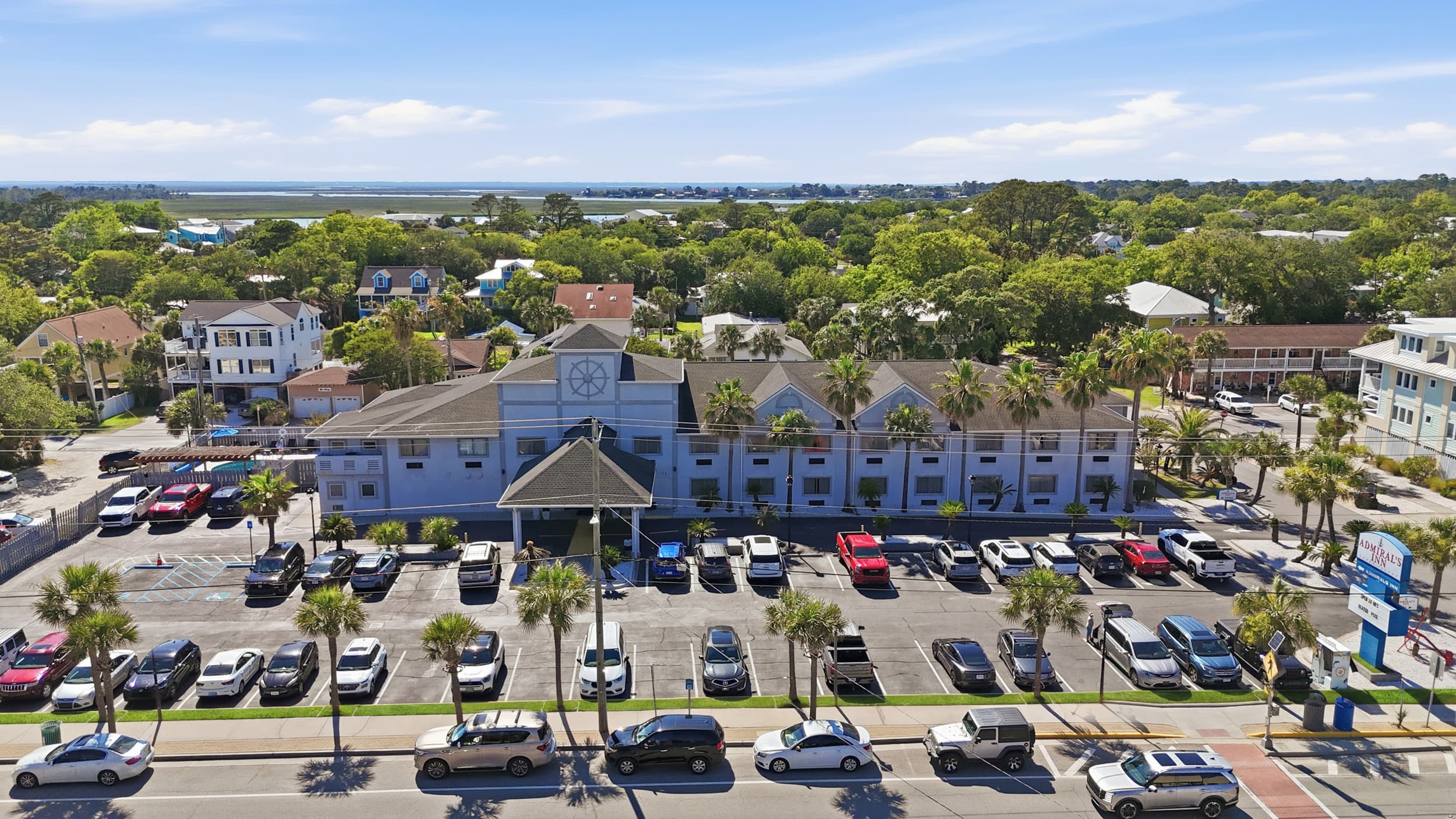
Our standing multi-night offers apply in September the same as any other month (two-night and three-night stays each carry a discount), and the rooms are a block off the beach either way. Planning a September stay? Check availability, and if that warm October water tempted you, the same page covers those dates too.
FAQ
Common questions.
Is September a good time to visit Tybee Island?
Yes, with the season understood. September water averages around 81°F at the NOAA gauge just behind the island, daytime air runs in the low 80s, and the island is noticeably calmer than at peak summer. It's also the statistical peak of Atlantic hurricane season. Most Septembers pass without a storm affecting the island, and NOAA's 2026 outlook gives this season a 75% chance of running below normal. Book, then check the National Hurricane Center map as your dates approach.
Does Tybee Island get hit by hurricanes often?
Direct hits are uncommon. The National Weather Service office in Charleston, whose forecast area covers Tybee, counts 41 tropical-cyclone landfalls in its multi-county coastal area between 1851 and 2018: roughly one every four years somewhere along that entire stretch of coast, with most activity between August and October. Storms are a real part of coastal Georgia life, but a storm interrupting any single week here is genuinely rare.
How warm is the water at Tybee Island in September?
Warm. NOAA's gauge at Fort Pulaski, just behind the island, has averaged 80.9°F in September over the past seven years: typically around 82–83°F early in the month, cooling toward 79–80°F by the end. The water stays swimmable into October, which averages about 74°F, roughly six degrees warmer than April at the same gauge.
What happens if a hurricane threatens Tybee Island during my stay?
Chatham County orders evacuations by zone. Its first tier is defined as 'areas east of the Truman Parkway and the Vernon River,' and Tybee sits well east of that line, so the beach goes early, not last. If an evacuation is ordered, leave promptly via US-80, the one road off the island. Follow the National Hurricane Center for the storm itself and Chatham Emergency Management (chathamemergency.org) for local orders.
When does hurricane season peak and end for Tybee Island?
The Atlantic hurricane season runs June 1 through November 30. The statistical peak is September 10, with most activity occurring between mid-August and mid-October, per the National Hurricane Center's climatology. By late October the tropics typically quiet down, while Tybee's water is still around 74°F, which is why fall is the island's warm shoulder season.
Planning a trip to Tybee?
We’re one block from the beach and one block from the pier.
Check Availability