Listicle
9 min read
6 Reasons to Visit Tybee Island in the Off-Season
The usual case for the off-season runs on crowd counts and rate drops nobody can source. Here are six reasons that hold up to a gauge reading or a posted schedule, starting with an ocean that's warmer in October than it is in April.
Edited by Admiral's Inn Editorial Team
The standard case for a beach town in its quiet half is built out of things nobody can prove. Fewer people. Cheaper rooms. The whole island to yourself. We went looking for numbers to put behind those claims and came back without any we would print, so this list does not use them.
What it uses instead is the material that shows up in a gauge reading, a posted schedule, or a rate sheet: how warm the water actually is in October, how long the evening light lasts, what the meter charges in February. Six of those held up. The seventh and eighth would have been the crowd and price claims, and we would rather run a short list than a padded one.
What counts as the off-season here
Tybee's busy stretch is summer, and the island's quiet half is everything on either side of it. Practically, that means the run from after summer's last weekend through the spring, with the two shoulders behaving very differently from the deep winter months in between. The most useful piece of it by a wide margin is October, and several of the reasons below are strongest in that window specifically.
If you want the whole calendar rather than the case for the quiet side of it, our month-by-month guide lays out water and air temperatures for all twelve.
1. October's water is warmer than April's
This is the fact that reorganizes the argument. NOAA runs a continuous water-temperature gauge at Fort Pulaski, just behind the island. Averaged over seven years of readings, October's mean comes out at 73.8°F. April's comes out at 67.8°F.
Six degrees, in favor of the month everyone treats as the end of the season over the month everyone treats as the start of it. The reason is simple: the ocean spends all summer banking heat and gives it back slowly, so the water lags the air by weeks. April has the blue sky and the warm sand and an ocean that is still catching up. October has an ocean that swims.
Two honest notes. The gauge sits in the river entrance behind the island rather than in the surf off the beach, so treat it as a good proxy and not a dipstick for the exact wave you will wade into. And the window is genuinely a window: November's mean drops to 65.2°F, which ends swimming for most people. If getting in the water matters, October is the last comfortable month.
The practical version of all this: if you are weighing an October trip you could take soon against a spring trip you would take later, and swimming is any part of why you are going, take the October one. That is not a marketing preference. It is a six-degree difference in the only number that decides whether anybody in your group actually gets in.
2. The pool stays warm after the ocean stops being warm
Here is the gap the off-season creates. Late in October, the water is still holding a swimmable temperature while the evening air has cooled enough that drying off is the unpleasant part. Push into November and December and the ocean is out of the running entirely.
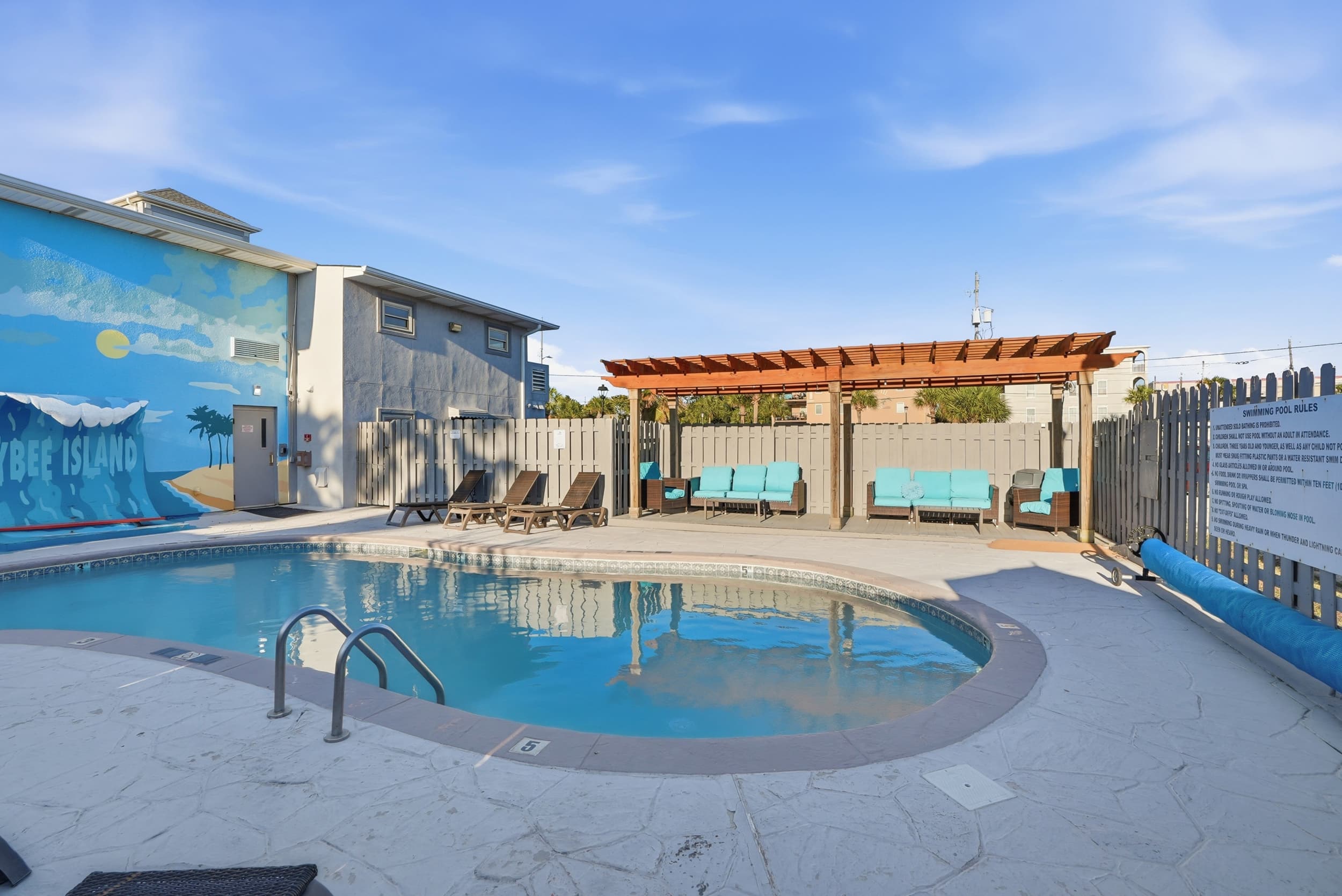
Our saltwater pool is heated through the cooler months, which is the plain answer to that problem: the swimming part of a Tybee trip does not have to end when the beach stops cooperating. It is the only heated pool among the five inns in our Tybee group, and it is the single amenity that changes what a January booking here is worth. There is a sun deck beside it and a pergola for the hours when you want to be outside without being in the sun. Full details are on the amenities page.
We will not oversell it. A heated pool in December is a heated pool in December, not a substitute for August. What it does is keep a cold-month stay from being a walking-only trip.
3. Turtle season runs through October
Sea turtle nesting season on Tybee runs May through October, per the Tybee Island Marine Science Center. October sits inside that, which means an off-season beach walk in the early shoulder is still a walk past marked nests.
You will recognize them: a wooden cage staked over the sand with tape around it. The rule is the same in October as in June. Give them room, keep lights and noise away from them after dark, and do not move anything. Nothing about this promises you a turtle. It does mean the beach in the first stretch of the off-season is still a working piece of habitat rather than an empty one, which is a different kind of walk than a February walk.
4. There is still enough evening for a walk after dinner
Daylight is the quiet cost of a fall trip, and it is worth knowing the exact shape of it before you plan around it. Sunset holds after 7 PM through the end of September. By mid-October it has slid to about 6:51 PM, and it keeps sliding.
What that buys you in the early shoulder is a real after-dinner beach walk, the thing that makes a September or early-October evening feel like summer even when the calendar disagrees. By the middle of October you want to reverse the order: walk, then eat. Our dining rundown covers where to land afterward, and if the light is the point of the trip, our guide to the island's sunset spots works in any month of the year.
5. You will find a parking spot. You will still pay for it.
This is where a lot of off-season writing about Tybee gets it wrong, so here is the exact rule. Paid parking is enforced citywide, 8 AM to 8 PM, every day of the year, weekends and holidays included, at $4.00 an hour, paid through the Park TYB app. There is no winter amnesty. There is no free season. February costs the same as July.
What changes is supply. The frustration of a summer Saturday on Tybee is not the four dollars, it is the circling, and the circling stops once summer does. In the quiet months you park where you actually wanted to park, which for most visitors is worth more than the fee ever was.
Guests here park free on site, one car per room, which takes the question off the table for the hotel end of the trip but not for the rest of the island. Budget for the meter wherever you are staying.
6. The things that involve climbing and walking get much easier
The island's two best pieces of history both ask something of you physically, and summer makes both of them harder than they need to be.
The Tybee Island Light Station is 178 steps to the top, with Georgia's oldest lighthouse tower around you and the whole island underneath when you get there. The ticket covers both keepers' cottages and the museum across the street, which is comfortably a half day if you read the placards. Fort Pulaski is about fifteen minutes by car: Civil War brickwork, marsh trails, and a slow two hours if you do it properly.
Neither of those is a heat activity. Doing them in the cool half of the year is not a consolation prize for missing beach season, it is the better version of the same day. The things-to-do page has the rest of the island's list, and most of it holds up year-round.
How we picked six
Every item above traces to one of three things: a NOAA or Naval Observatory reading, a schedule or season published by the organization that runs it, or a fact about our own property that we can answer for at the front desk.
Two popular off-season arguments did not survive that test. The first is crowd size, where we could not find a figure worth quoting for Tybee specifically. The second is rates, same problem. Both are probably directionally true and neither is something we are willing to put a number on, so they are not on the list. A third, the claim that restaurants across the island shorten their hours off-season, is the kind of general statement that gets a reader driving across the island for a closed door. We left it out rather than assert it broadly.
That is why this is six.
What the off-season does not give you
An honest list needs the other column.
Swimming in open water ends. November's 65.2°F is a wading temperature, not a swimming one, and the months after it are colder still. The evening light goes early and keeps going earlier, which compresses the after-work half of a day more than most people expect. And schedules move around outside of summer, so check the hours for any specific place the morning you plan to go rather than assuming what was true in July.
None of that is a reason to skip the season. It is a reason to plan the day in a slightly different order.
Who the quiet season actually suits
Three fairly different trips fit into it, and they do not all want the same weeks.
If swimming is the point and you missed summer, you want the front edge: the early shoulder, aimed at October rather than past it, with the water reason above doing the deciding.
If you came for the island's history, the opposite is true and you have months of runway. The lighthouse steps and the fort's marsh trails are better in cool air, and they are open well outside beach season.
And if Tybee is your base for Savannah rather than the whole trip, the quiet months are the strongest case of all. Downtown is roughly half an hour away, it is a walking city, and walking it is easier when the heat has let go. You come back in the evening to an island at low idle instead of a causeway backed up with day traffic.
Making the trip work
The inn is a block off the beach and a block from the pier, parking is complimentary on site, and the pool is heated through the cooler months, which is the piece that makes an October-through-April stay swimmable at all. The rooms sleep up to four either way. Multi-night stays carry a discount year-round through our standing offers, which is worth a look if the quiet season is when you like to stay longer.
Picking dates? Check availability here. If the water temperature is what convinced you, aim at October and go early in it.
FAQ
Common questions.
Is the ocean warm enough to swim at Tybee Island in October?
Yes, for most people. NOAA's gauge at Fort Pulaski, just behind the island, puts October's mean water temperature at 73.8°F. That is about six degrees warmer than April, which most visitors assume is the equivalent month. November falls to 65.2°F, which closes the season for all but the hardiest.
Is parking free on Tybee Island in the off-season?
No. Tybee enforces paid parking citywide from 8 AM to 8 PM every day of the year, weekends and holidays included, at $4.00 an hour, paid through the Park TYB app. The off-season difference is availability, not price: you will find a space, and you will still pay for it. On-site parking at the inn is complimentary for guests, one car per room.
Can you still see sea turtle nests on Tybee Island in the fall?
Sea turtle nesting season on Tybee runs May through October according to the Tybee Island Marine Science Center, so marked nests can still be on the beach into the fall. Nests are flagged with a wooden cage and tape. Give them a wide berth and keep lights and movement away from them after dark.
How late is it light on Tybee Island in the fall?
Sunset stays after 7 PM through the end of September and slips to about 6:51 PM by mid-October (US Naval Observatory). Early fall leaves room for a beach walk after dinner. By mid-October it is worth flipping the order and walking first.
Does Admiral's Inn have a heated pool?
Yes. The saltwater pool is heated through the cooler months, so it is swimmable most of the year, with a sun deck and a pergola beside it. It is the only heated pool among the five inns in our Tybee group.
Planning a trip to Tybee?
We’re one block from the beach and one block from the pier.
Check Availability